
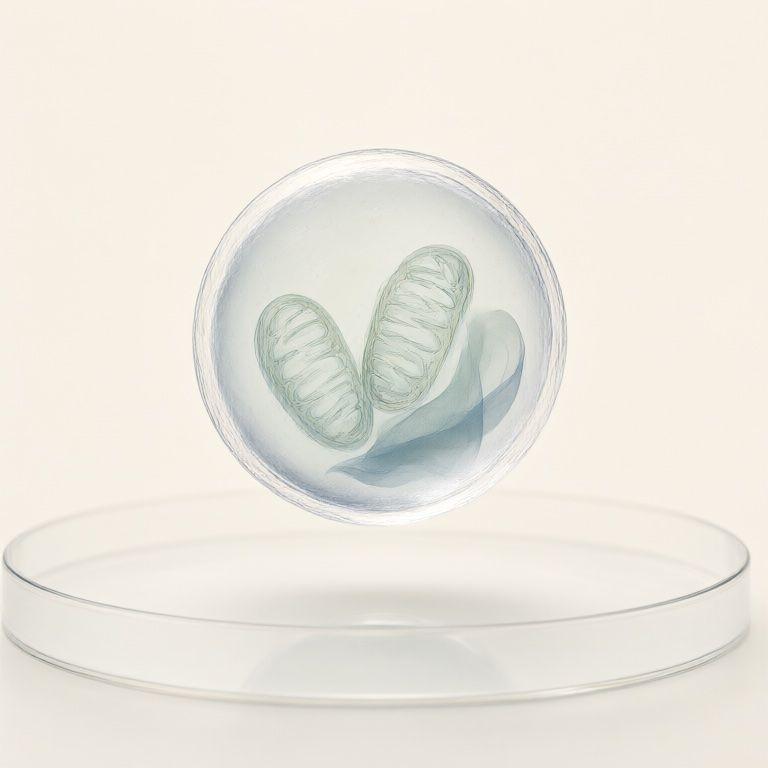
A Mitochondrial Peptide Just Rejuvenated Aged Human Eggs in the Lab. Here's What the Science Actually Shows.
Elamipretide restored egg quality in aged mice and improved maturation of aged human oocytes in a new Aging Cell study. The drug is already FDA-approved for a rare disease. Does that make it a fertility breakthrough — or another promising mouse story? We read the paper.
A fertility clinic in Guangxi and a lab in Nanjing just published something unusual: an already-approved drug that made aged human eggs behave like younger ones in a petri dish. Not younger-looking. Younger-functioning — maturing, fertilizing, and dividing more like eggs from a younger donor.
The drug is elamipretide, a four-amino-acid peptide you may know as SS-31. It was approved by the FDA in 2025 for Barth syndrome, an ultrarare mitochondrial disease. And now a team writing in Aging Cell claims it can rejuvenate oocyte quality and restore fertility in aged mice — and improve the maturation of aged human eggs in the lab.
Before anyone books a flight to a fertility clinic, there is a complication. This same peptide failed a phase 3 trial in humans a few years ago. Both facts are true, and holding them both at once is the only honest way to read this study.
What the Study Actually Found
The paper, led by Zhang and colleagues at Nanjing Agricultural University with clinical collaborators at a Guangxi reproductive medicine center, tested elamipretide in aged female mice. The headline results: treated mice had larger litters, and their eggs showed measurably less age-related decline.
That mouse result alone would be forgettable. Mouse fertility studies fail to translate constantly. What makes this paper get attention is the human-tissue work sitting alongside it.
The team took aged human oocytes — donated eggs from older patients, the kind that usually struggle in IVF — and exposed them to elamipretide in culture. Treated eggs showed better maturation, better fertilization, and better early cleavage than untreated controls. They repeated the effect in pig eggs stressed with oxidative damage, and the peptide rescued developmental competence there too.
Metabolomic and transcriptomic profiling gave the mechanism a shape: treated aged eggs showed restoration of multiple biological processes, better cytoskeletal dynamics, healthier mitochondrial metabolism, and reorganized organelles. The authors trace the effect to synergistic activation of what they call the vitamin B6–VEGF axis — two signaling systems, neither of which is exotic, doing work that looks coordinated.

Why mitochondria? Because the egg is the most mitochondria-rich cell in the human body, carrying somewhere between 100,000 and 600,000 of them. Mitochondrial decline is one of the leading explanations for why egg quality falls with age, and elamipretide happens to be the most clinically advanced mitochondrial peptide in existence. It binds cardiolipin, a lipid that only exists in the inner mitochondrial membrane, and stabilizes the structures mitochondria use to make energy.
The Complication: This Drug Already Failed a Phase 3
Here is the part a press release would leave out.
Elamipretide's road to approval runs through MMPOWER-3, a phase 3 randomized, double-blind, placebo-controlled trial in 218 people with primary mitochondrial myopathy. Participants injected 40 mg daily under the skin for 24 weeks. The trial missed both primary endpoints — walking distance and fatigue scores showed no meaningful difference from placebo. The 6-minute walk test difference was minus 3.2 meters, statistically indistinguishable from nothing.
The drug was well tolerated, which is why it stayed in development. And in 2025 the FDA granted accelerated approval for FORZINITY, elamipretide's brand name, specifically to improve muscle strength in Barth syndrome patients weighing at least 30 kg — the first cardiolipin-directed mitochondrial therapy ever approved. A 2026 review in Drug Discovery and Therapeutics calls it the first of its class; a September 2026 analysis in the International Journal of Molecular Sciences notes that cardiac disease modification remains unconfirmed even in Barth syndrome.
So the same molecule has: one accelerated approval in an ultrarare disease, one failed phase 3 in a related population, and now one striking preclinical fertility result.
This pattern is not a scandal. It is what peptide drug development looks like. Accelerated approval means the FDA judged the Barth syndrome data promising enough to grant access while confirmatory evidence is still collected. It is not a declaration that the drug works for everything mitochondria touch — and fertility is a long way from Barth syndrome.
What This Means If You Care About Fertility
Let's be precise about what exists and what doesn't.
What exists: aged human eggs, in a dish, exposed to elamipretide, matured and fertilized better than untreated aged eggs. That is a real, published, peer-reviewed result in a respectable journal.
What doesn't exist: any clinical trial of elamipretide for fertility. Any pregnancy data. Any live birth data. Any safety data on taking the drug while trying to conceive. Any published dosing regimen that gets meaningful drug levels into an ovary. The human results are from donated research oocytes, not from women who took the drug.
The gap between those two lists is where every honest fertility headline has to live. In-vitro oocyte improvement is a genuinely interesting signal — it is the kind of result that eventually becomes an IVF lab protocol — but it is not a treatment you can take.
And there is a realistic near-term path worth watching. Before anyone injects patients, reproductive medicine groups could test the simpler version: exposing donated eggs to elamipretide in culture during IVF, the way labs already handle eggs with activation compounds. If the Guangxi result replicates across independent labs, that is where it lands first — a lab adjunct, not a prescription.
For now, buying research-grade SS-31 online and self-injecting before an IVF cycle is an experiment with an unknown protocol, unknown ovarian dosing, and no pregnancy safety data. The mouse litter-size result is encouraging. It is not a protocol.
The Oria Take
Elamipretide has been on our radar for years as the most clinically mature mitochondrial peptide — it is covered in depth in our SS-31 guide. What this Aging Cell paper adds is a genuinely new therapeutic direction: reproductive aging, one of the few areas of age-related decline with an enormous clinical market and almost no approved interventions.
Three things we'll be watching over the next 12–24 months:
First, replication. Independent reproductive medicine labs confirming the human oocyte maturation finding would move this from single-study curiosity to a real research program.
Second, trial registrations. A ClinicalTrials.gov entry for elamipretide in ovarian aging, diminished ovarian reserve, or IVF adjunct use would be the signal that the field takes this seriously.
Third, the B6–VEGF axis. If that mechanism holds, it suggests mitochondrial support and vascular growth signaling are coupled in egg aging — which would open the door to cheaper, better-studied interventions targeting the same axis.
The bigger picture: mitochondrial peptides keep showing up wherever cells are energy-hungry and age hits hardest. Heart, muscle, retina, and now eggs. The 2026 literature is dense with this signal — SS-31 attenuating radiation-induced cardiomyocyte senescence in rats, comparisons against MitoQ in aged mice with fatty liver disease, and reviews of the entire cardiolipin-targeting class. Ovarian aging may simply be the newest front in an old war.
Evidence Grade: C+ (preclinical promise with human-cell corroboration)
Mouse fertility restoration and aged human oocyte improvement in vitro, published in a credible peer-reviewed journal (Aging Cell). But zero human clinical fertility outcomes, a failed phase 3 in a related mitochondrial disease population, and human data limited to lab-dish endpoints (maturation, fertilization, cleavage) — not pregnancies or live births. Interesting enough to track closely, not established enough to act on.
Sources
1. Zhang HL, Wang Y, Wang C, et al. Elamipretide Rejuvenates Oocyte Quality and Restores Female Fertility During Reproductive Aging. Aging Cell. 2026 Oct;25(10):e70749. doi:10.1111/acel.70749. PMID: 42827331.
2. Karaa A, Bertini E, Carelli V, et al. Efficacy and Safety of Elamipretide in Individuals With Primary Mitochondrial Myopathy: The MMPOWER-3 Randomized Clinical Trial. Neurology. 2023;101(3):e238-e252. PMID: 37268435.
3. Lee CL, Chuang CK, Chang YH, et al. Mitochondrial Quality Control in Inherited Mitochondrial Cardiomyopathy. Int J Mol Sci. 2026 Sep;27(18):8270. PMID: 42794697.
4. Wang LT, Jhuang HY. Clinical development in primary mitochondrial diseases at a translational inflection point. Biomed Pharmacother. 2026 Aug;201:119699. PMID: 42361626.
5. Elamipretide: The first cardiolipin-directed mitochondrial therapeutic for Barth syndrome approved under accelerated approval. Drug Discov Ther. 2026 Jan. PMID: 41260682.
6. Flavin B, Vernon HJ, Todd Cade W, et al. AMCP Market Insights: Managed care considerations in Barth syndrome. J Manag Care Spec Pharm. 2026 Jul;32(7-b Suppl):S1-S10. PMID: 42359884.
Medical Disclaimer
This article is for educational and informational purposes only and does not constitute medical advice. Elamipretide is not approved for any fertility indication. Peptides discussed here are research compounds in most contexts; their safety in pregnancy or conception attempts is unknown. Always consult a licensed physician — ideally a reproductive endocrinologist — before making any decision about fertility treatment. This is part of why Oria exists: physician-supervised, evidence-based guidance instead of guesswork from the internet.
Related Compounds
Explore Reconstitution Math & Research Reports
Use our interactive U-100 Reconstitution Calculator or browse evidence-graded literature summaries.