
Peptide Guide & Calculator
How to Reconstitute Peptides: Step by Step Practical Guide
Executive Brief
Reconstitution is the process of dissolving lyophilized (freeze-dried) peptide powder with bacteriostatic water (0.9% benzyl alcohol) to create a measured liquid solution. Below you will find our interactive U-100 Reconstitution Calculator, syringe & needle size reference tables, 5mg/10mg concentration examples, and cold-storage stability data.
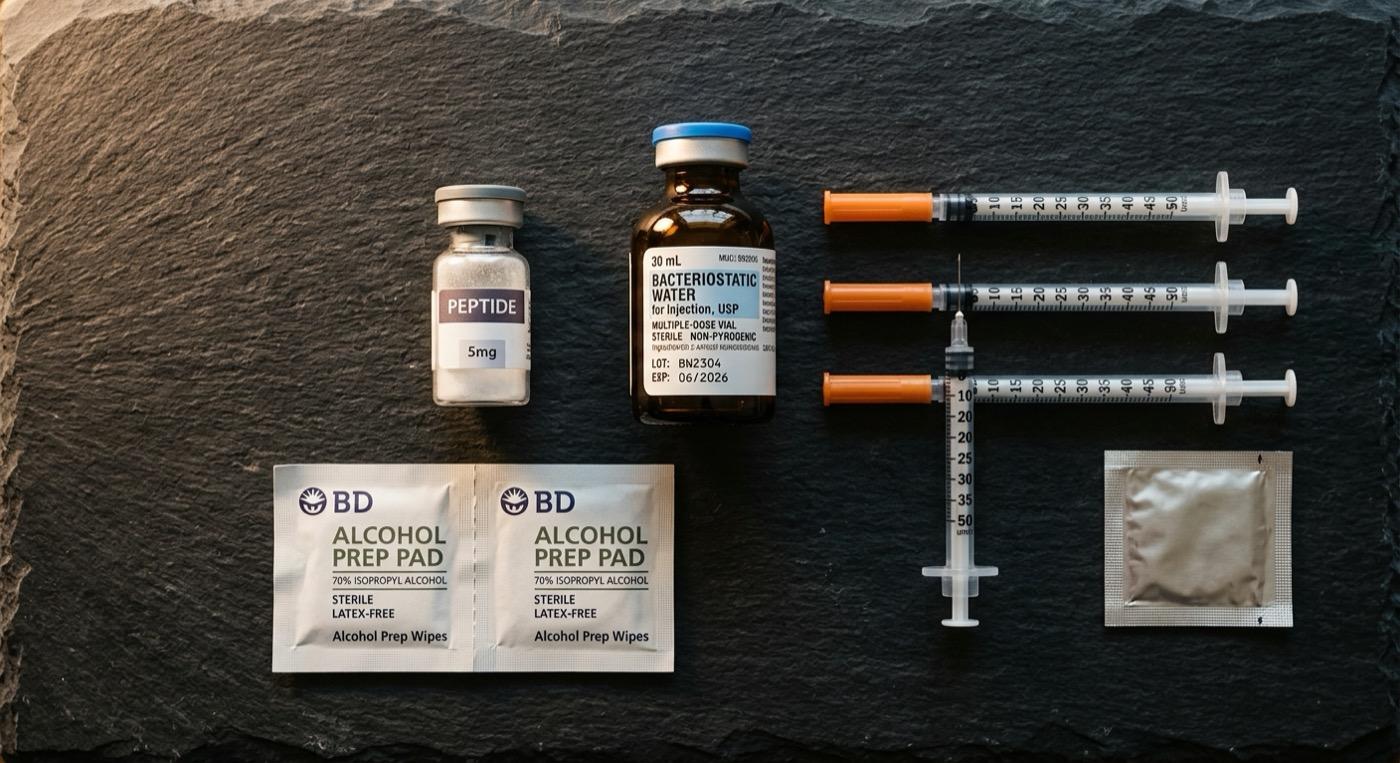
Step-by-step protocol & U-100 unit math
U-100 Insulin Syringe & Needle Size Reference Table
Selecting the right reconstitution syringe and needle gauge prevents rubber-stopper coring and allows accurate reading of small microgram aliquots. Standard U-100 insulin syringes are calibrated so that 100 units = 1.0 mL (therefore 1 unit = 0.01 mL).
| Syringe Barrel / Gauge | Total Volume & Scale | Needle Length | Primary Laboratory / Research Use Case |
|---|---|---|---|
| 0.3 mL (30-Unit) · 31G | 0.30 mL = 30 U-100 units (half-unit markings) | 8 mm (5/16") or 6 mm (15/64") | Highest precision for small aliquots (2–25 units), such as low-volume GLP-1 or 250 mcg BPC-157 draws. |
| 0.5 mL (50-Unit) · 30G–31G | 0.50 mL = 50 U-100 units (1-unit markings) | 8 mm (5/16") | Versatile all-purpose measurement syringe for standard 10–40 unit aliquots. |
| 1.0 mL (100-Unit) · 29G–30G | 1.00 mL = 100 U-100 units (2-unit markings) | 8 mm (5/16") or 12.7 mm (1/2") | Best for transferring 1.0 mL or 2.0 mL of bacteriostatic water during reconstitution. |
| 3.0 mL Luer-Lock · 25G–27G | 3.00 mL graduated in 0.1 mL increments | 12.7 mm–25 mm (1/2"–1") | Used exclusively for drawing and adding 2–3 mL of BAC water in a single pass; never for microgram aliquot measurement. |
5mg & 10mg Semaglutide and BPC-157 Concentration Math Examples
| Compound & Vial Mass | BAC Water Added | Resulting Concentration | Example Target Aliquot → U-100 Units |
|---|---|---|---|
| BPC-157 (5 mg = 5,000 mcg) | 2.0 mL (200 units) | 25 mcg per unit (2.5 mg/mL) | 250 mcg = 10 units · 500 mcg = 20 units |
| BPC-157 (10 mg = 10,000 mcg) | 2.0 mL (200 units) | 50 mcg per unit (5.0 mg/mL) | 250 mcg = 5 units · 500 mcg = 10 units |
| Semaglutide (5 mg = 5,000 mcg) | 2.0 mL (200 units) | 25 mcg per unit (2.5 mg/mL) | 0.25 mg (250 mcg) = 10 units · 0.5 mg = 20 units · 1.0 mg = 40 units |
| Semaglutide (10 mg = 10,000 mcg) | 2.0 mL (200 units) | 50 mcg per unit (5.0 mg/mL) | 0.25 mg (250 mcg) = 5 units · 0.5 mg = 10 units · 1.0 mg = 20 units |
Where reconstitution knowledge comes from
Peptide reconstitution borrows directly from parenteral hormone and insulin preparation, which has been standard clinical practice for over 40 years. The equipment is identical: U-100 graduated syringes, bacteriostatic water (0.9% benzyl alcohol), and sterile lyophilized crimp-top vials. Not all peptides dissolve at the same rate: some dissolve on contact, while others require gentle swirling and patience. Mechanical agitation—shaking or vigorous vortexing—can shear and denature fragile peptide chains.
How reconstitution works (Step-by-Step)
Lyophilized peptides are stored as a freeze-dried cake or powder in sealed vials under partial vacuum. Once sterile diluent is introduced, hydrolytic and oxidative degradation begins. Bacteriostatic water is sterile water formulated with 0.9% benzyl alcohol as a preservative, preventing bacterial proliferation for up to 28 days under refrigeration (2°C to 8°C).
Prepare the lyophilized peptide vial, bacteriostatic water (0.9% benzyl alcohol), 70% isopropyl alcohol prep pads, a 1.0 mL diluent syringe, and a clean workspace.
Pop the plastic flip-off caps from both vials. Wipe the rubber stoppers of the peptide vial and the BAC water vial with fresh 70% isopropyl alcohol swabs and allow them to air-dry for 10 seconds.
Pull back the plunger to draw air equal to your target diluent volume (e.g., 1.0 mL or 2.0 mL). Insert the needle through the center of the BAC water stopper, push the air in to equalize vial pressure, invert the vial, and slowly draw the exact volume of BAC water.
Insert the needle into the lyophilized peptide vial at a 45-degree angle so the bevel touches the inside glass wall. Depress the plunger slowly, letting the water run down the glass rather than spraying directly onto the lyophilized powder cake.
Remove the needle and gently roll the vial between your palms for 30–60 seconds. Never shake a peptide vial; foaming and shear stress can denature the peptide. Allow stubborn lyophilized cakes 5–15 minutes to turn completely clear.
Use the interactive U-100 Reconstitution Calculator above to confirm the concentration in mcg per unit, write the reconstitution date and concentration on the vial label, and store immediately at 2°C–8°C.
Bacteriostatic water ratios
Concentration Formula Explained
The mathematical relationship between lyophilized vial mass, diluent volume, and U-100 syringe units follows three steps:
1. Total Micrograms in Vial = Vial Mass (mg) × 1,000
2. Total U-100 Units in Vial = Bacteriostatic Water Added (mL) × 100
3. Concentration (mcg / unit) = Total Micrograms ÷ Total U-100 Units
4. Units to Draw = Target Aliquot (mcg) ÷ Concentration (mcg / unit)
Example A (5 mg BPC-157 + 2 mL BAC Water): 5 mg = 5,000 mcg. 2 mL = 200 U-100 units. Concentration = 5,000 ÷ 200 = 25 mcg per unit. For a 250 mcg aliquot: 250 ÷ 25 = 10 units on a U-100 syringe (0.10 mL).
Example B (10 mg Semaglutide + 2 mL BAC Water): 10 mg = 10,000 mcg. 2 mL = 200 U-100 units. Concentration = 10,000 ÷ 200 = 50 mcg per unit. For a 0.25 mg (250 mcg) aliquot: 250 ÷ 50 = 5 units on a U-100 syringe (0.05 mL).
Subcutaneous Administration Context in Published Literature
In clinical trials of subcutaneous peptides, researchers rotate anatomical sites (abdomen at least 2 inches from the umbilicus, outer thigh, or upper arm) to prevent lipohypertrophy and localized tissue irritation. Short 8 mm (5/16 inch), 31-gauge needles are standard in subcutaneous trial protocols.
Storage and Stability Windows (2°C to 8°C)
Reconstituted peptides must be stored in a refrigerator (2°C to 8°C) away from light. Typical refrigerated stability windows reported in compounding and research literature include:
- BPC-157: 21 to 28 days refrigerated
- CJC-1295 / Ipamorelin: 21 to 28 days refrigerated
- TB-500 (Thymosin Beta-4): 21 to 28 days refrigerated
- GHK-Cu: Up to 28 days refrigerated
- Semaglutide / Tirzepatide: Up to 28 days refrigerated in bacteriostatic water
Unreconstituted lyophilized (dry) vials should be stored in a freezer (-20°C) for long-term preservation or a refrigerator (2°C–8°C) for medium-term storage. Never freeze a liquid peptide after reconstitution, as ice crystal formation shears peptide bonds.
Frequently Asked Questions
What is bacteriostatic water and can I use regular sterile water?
Bacteriostatic water (BAC water) is sterile water containing 0.9% benzyl alcohol as a bacteriostatic preservative, which inhibits bacterial growth for up to 28 days after the vial stopper is punctured. Regular sterile water contains no preservative and must be used in a single draw or discarded within 24 hours.
What size needle and reconstitution syringe should be used to reconstitute peptides?
In laboratory and clinical workflows, two syringe applications are common: a 1.0 mL (100-unit) syringe with a 27G–30G needle (1/2 inch / 12.7 mm) is often used to transfer bacteriostatic water into the lyophilized vial, while a U-100 insulin syringe with an ultra-fine 31G, 8 mm (5/16 inch) needle in 0.3 mL (30-unit) or 0.5 mL (50-unit) capacity is used for measuring small microgram aliquots accurately.
How do you calculate reconstitution math for a 5mg or 10mg Semaglutide or BPC-157 vial?
Divide the total peptide mass in micrograms (1 mg = 1,000 mcg) by the total U-100 syringe units of bacteriostatic water added (1 mL = 100 units). For a 5 mg (5,000 mcg) BPC-157 vial reconstituted with 2 mL (200 units) of BAC water, concentration is 25 mcg per unit (10 units = 250 mcg). For a 10 mg (10,000 mcg) Semaglutide vial reconstituted with 2 mL (200 units) of BAC water, concentration is 50 mcg per unit (5 units = 250 mcg / 0.25 mg).
How much BAC water should I add to my peptide vial?
Adding 1 mL to 2 mL of bacteriostatic water is standard for 2 mL–3 mL lyophilized vials. The volume of diluent changes the concentration per syringe unit, not the total mass of peptide in the vial. Adding 2 mL to a 5 mg vial yields 25 mcg per U-100 unit; adding 1 mL yields 50 mcg per U-100 unit.
Can I mix two peptides in the same syringe?
In general, no. Different peptides have distinct isoelectric points, pH stability windows, and excipient profiles. Mixing separate solutions in a single barrel can cause peptide aggregation, precipitation, or premature degradation.
Why is my lyophilized peptide not dissolving completely?
Allow the vial to sit at room temperature for 10 to 15 minutes and gently roll it between your palms—never shake a peptide vial, as mechanical shear denatures fragile peptide chains. Persistent cloudiness or particulate matter after 15 minutes indicates degradation or impurity, and the vial should be discarded.
Research & Mathematical Utility Disclaimer
All content and unit-conversion tools on this page are provided strictly for informational and educational research purposes based on preliminary clinical data and anecdotal user experience only. Nothing here has a medical foundation or constitutes medical advice, diagnosis, or dosing instruction. Always consult a licensed physician before considering any compound.
Compounds Mentioned
Related Guides
Peptide Stacking Guide for Beginners
How to combine peptides safely — synergistic stacks, timing, and common mistakes to avoid.
Best Peptide for Weight Loss
Comparing semaglutide, tirzepatide, retatrutide, and other peptides for fat loss — mechanisms, results, and trade-offs.
Microdosing Semaglutide & Tirzepatide
Why researchers are microdosing GLP-1 agonists — lower doses, fewer side effects, cost savings.
Next-Generation Weight Loss Drugs
Beyond semaglutide — retatrutide, survodutide, and the triple-agonist pipeline.