
GLP-1 Drugs, Anxiety, and Depression: What the New Data Actually Says
A large real-world study just compared semaglutide and tirzepatide to older weight-loss drugs on mental health outcomes. The results split in an unexpected direction.
The Study That Changed the Conversation
For two years, the debate around GLP-1 drugs and mental health has been stuck in a loop. Reports of suicidal ideation triggered an FDA safety review. Social media threads swung between people claiming semaglutide cured their anxiety and others swearing it triggered panic attacks. Meanwhile, the actual data was sparse and mostly based on pharmacovigilance databases — useful for catching red flags, but terrible for answering the real question: do these drugs make mental health better or worse?
A study published in Communications Medicine in June 2026 finally moved the needle. Researchers at National Chung Hsing University and the University of Wollongong used a US electronic health record network covering 2020 to 2025 to compare neuropsychiatric outcomes in adults with obesity who started tirzepatide or semaglutide against matched users of three older weight-loss medications: naltrexone-bupropion, phentermine, and phentermine-topiramate. They followed patients for up to 24 months and tracked new diagnoses of anxiety, depression, mood disorders, cognitive deficits, insomnia, and substance-related disorders.
This is not a small observational snapshot. It is the largest real-world comparison of mental health outcomes across obesity drugs to date, and the findings are more nuanced than either camp in the GLP-1 mental health debate would like.

What the Numbers Show
Against naltrexone-bupropion — a drug specifically approved for weight management that contains an antidepressant — semaglutide users with type 2 diabetes showed a 33% lower hazard of anxiety disorders (HR 0.67) and a 31% lower hazard of depression (HR 0.69). Tirzepatide users did even better on anxiety: a 45% reduction (HR 0.55) and a 51% reduction in depression (HR 0.49). These are not subtle signals.
In adults without type 2 diabetes, the pattern held. Semaglutide users had a 27% lower hazard of anxiety (HR 0.73) and a 47% lower hazard of depression (HR 0.53) compared to naltrexone-bupropion. Tirzepatide users showed an 11% reduction in anxiety (HR 0.78) and a 43% reduction in depression (HR 0.57).
Both drugs also showed lower hazards of mood disorders and broadly defined cognitive deficits compared to the older medications. People on incretin therapies were less likely to be prescribed SSRIs during the follow-up period. On the surface, this looks like a clear win for GLP-1 drugs on mental health.
The Tirzepatide Caveat
Here is where it gets complicated. When the researchers compared tirzepatide directly against semaglutide in adults without type 2 diabetes, tirzepatide showed higher hazards of anxiety disorders (HR 1.12) and insomnia (HR 1.13). That is a 12% and 13% relative increase, respectively.
This finding aligns with what Reddit communities have been reporting for months. Users on r/tirzepatidecompound describe both sides: some call tirzepatide life-changing for mental health, while others report new-onset panic attacks and insomnia. One user wrote that tirzepatide was the only medication to ever help their severe mental health issues. Another described the worst panic attack of their life after their second dose.
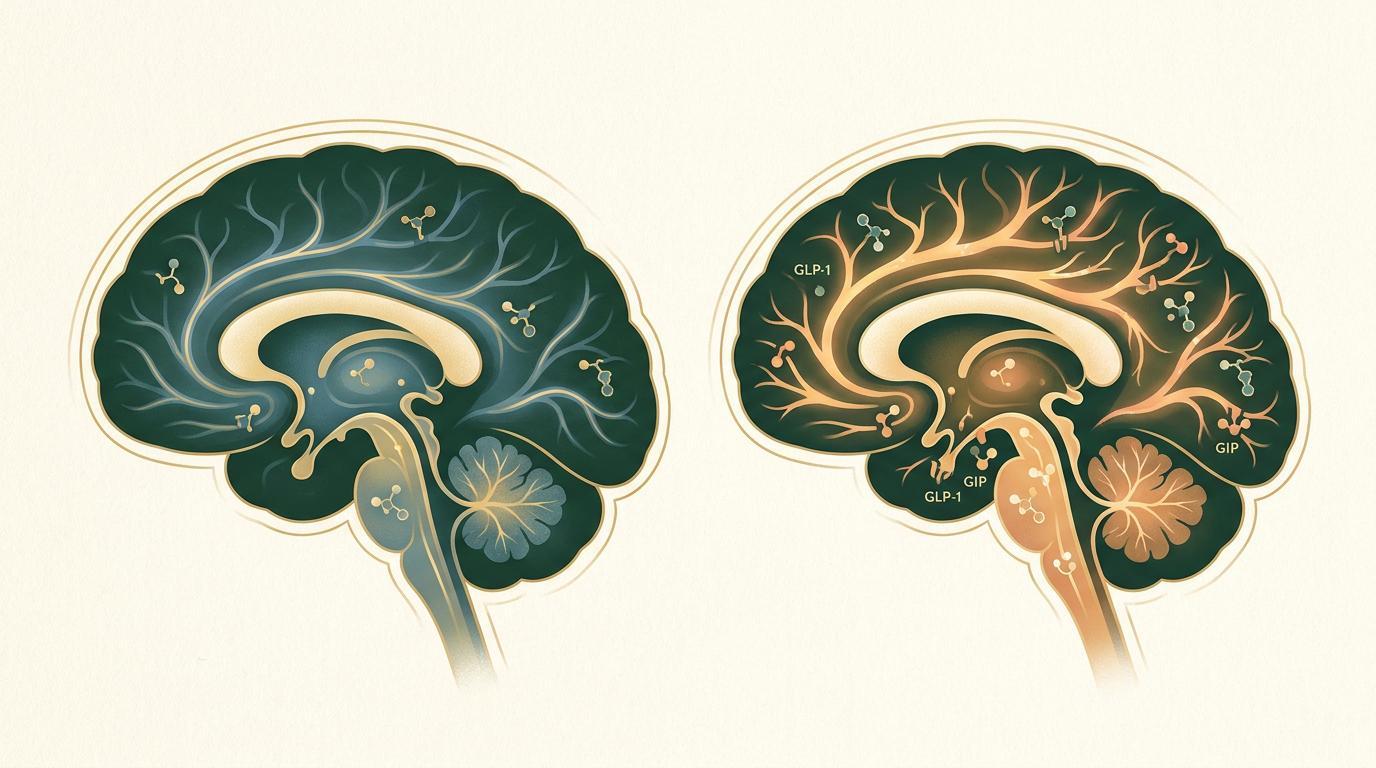
The likely explanation lies in tirzepatide's dual mechanism. It activates both GLP-1 and GIP (glucose-dependent insulinotropic polypeptide) receptors. GIP receptors are distributed differently in the brain than GLP-1 receptors, and their interaction with anxiety and arousal pathways is less well understood. The additional GIP activation may produce a more stimulating neurological profile in some individuals, which could explain the anxiety and insomnia signal.
Semaglutide, by contrast, is a pure GLP-1 receptor agonist. Its mental health profile was more uniformly positive in this study, with lower hazards across anxiety, depression, mood disorders, and cognitive deficits in most comparisons.
Why GLP-1 Drugs Might Help Anxiety and Depression
The biological plausibility is actually stronger than most people realize. GLP-1 receptors are expressed throughout the brain, including the hippocampus, hypothalamus, amygdala, and prefrontal cortex — the regions most implicated in anxiety and depression.
Preclinical research has identified at least four pathways through which GLP-1 receptor activation could improve mental health:
Neuroinflammation reduction. GLP-1 agonists decrease the production of pro-inflammatory cytokines (IL-6, TNF-alpha) and reduce oxidative stress in the brain. Chronic neuroinflammation is increasingly recognized as a driver of treatment-resistant depression.
Neurotransmitter modulation. GLP-1 signaling influences both dopamine and serotonin pathways. This is the same neurotransmitter system targeted by SSRIs and SNRIs, but through a different upstream mechanism.
Neurogenesis support. Animal studies show GLP-1 agonists promote hippocampal neurogenesis — the growth of new brain cells in the region associated with mood regulation and memory.
Appetite-craving circuit normalization. GLP-1 drugs reduce activity in reward-seeking neural circuits. For people whose anxiety and depression are tangled up with disordered eating, food noise, or substance use, this downstream effect may be as important as the direct neurological action.
What This Means If You Are Choosing a GLP-1 Drug
If you have a history of anxiety or panic disorder and you are deciding between semaglutide and tirzepatide, this study gives you a data point worth discussing with your prescriber. Semaglutide had a cleaner mental health profile across the board. Tirzepatide produced larger weight loss and better metabolic outcomes in prior trials, but its dual-receptor mechanism may come with a slightly higher risk of anxiety and insomnia in some people.
That said, the absolute risk differences were modest. The tirzepatide-versus-semaglutide comparison showed relative increases of 12-13%, not a doubling of risk. And for people with type 2 diabetes, the head-to-head comparison did not show the same anxiety signal. The caveat applies primarily to people using these drugs for obesity without diabetes.
The broader takeaway is that the mental health effects of GLP-1 drugs are not uniform. They depend on the specific drug, the patient's metabolic status, their psychiatric history, and probably their individual neurobiology. A drug that calms one person's anxiety may trigger another's. The era of treating GLP-1 drugs as a monolithic category for mental health effects needs to end.
The Limits of This Data
This study has real limitations that matter for how you interpret the findings. It is observational, not a randomized trial. The researchers used diagnosis codes from electronic health records, which can be inaccurate — a doctor might code anxiety as a reason for a visit without formally diagnosing an anxiety disorder, or vice versa. Propensity score matching controls for measured confounders, but unmeasured confounders remain. People who choose tirzepatide may differ from those who choose semaglutide in ways the data cannot capture.
The cognitive deficit findings are especially sensitive to how outcomes were defined. The study authors acknowledge this explicitly. And the bariatric surgery comparator group, while interesting, introduces additional confounding since surgery patients are a self-selected group with different health profiles and follow-up patterns.
What this study does not say: it does not prove that GLP-1 drugs treat depression or anxiety. It shows an association with lower rates of new psychiatric diagnoses compared to older weight-loss drugs. The mechanism could be direct (drug acts on brain), indirect (weight loss improves mood), or confounded (people who respond well to GLP-1s are systematically different from those who choose older drugs).
The Oria Take
The GLP-1 mental health story is maturing past the fear phase. The FDA's 2024 safety review found no clear signal of increased suicidal ideation. This 2026 study goes further — it suggests these drugs may actually be associated with better mental health outcomes than older weight-loss medications, at least as measured by clinical diagnosis rates.
But the tirzepatide anxiety signal is a reminder that more receptor activity is not always better. The peptide therapy space has a tendency to assume that hitting more targets produces more benefits. This study challenges that assumption in a specific, measurable way. If you are exploring peptide-based approaches to metabolic health, the choice of compound matters — not just for weight loss, but for how your brain responds.
For people currently on or considering GLP-1 therapy, track your mental health the same way you track your weight. Note changes in anxiety, sleep quality, mood, and energy. If you notice new symptoms after starting or switching medications, that data point matters. Bring it to your prescriber. The clinical evidence is catching up to what patients have been reporting for years, and your experience is part of that picture.
Evidence Grade
Evidence Grade: B — Observational real-world data with large sample size and propensity score matching. Not a randomized controlled trial. Consistent with prior mechanistic research on GLP-1 receptor agonists and neuroinflammation. Strong signal but requires prospective confirmation.
Medical Disclaimer
This article is for informational purposes only and does not constitute medical advice. Peptide therapies and GLP-1 receptor agonists are prescription medications that should only be used under the supervision of a licensed healthcare provider. The information presented here is based on published research and should not be used to self-diagnose, self-treat, or modify any prescribed medication regimen. Always consult with a qualified healthcare provider before starting, stopping, or changing any treatment. Oria BioStack provides educational content about peptide science and metabolic health — we do not sell, prescribe, or distribute any medications or peptide compounds.
Related Compounds
Build Your Personalised Protocol
Turn your research into a personalised supplementation protocol with the BioStack Generator.