
Do GLP-1 Drugs Sabotage Fat Grafts? What the Latest Surgery Data Actually Shows
New studies show semaglutide users face a 45% complication rate in cosmetic surgery. Here's why GLP-1 drugs interfere with fat graft biology and what surgeons are doing about it.
The Collision Nobody Talks About
Here is a number that should stop every plastic surgeon mid-suture: 45 percent. That is the postoperative complication rate for patients who continued taking semaglutide right up to the day of their abdominoplasty, according to a June 2026 retrospective study published in Aesthetic Plastic Surgery. For patients who stopped the drug four weeks before surgery, that number dropped to 10 percent, identical to people who had never touched a GLP-1 receptor agonist.
The collision between weight-loss medications and cosmetic surgery has been building for years. More than 15 million Americans now take GLP-1 drugs like semaglutide and tirzepatide. Many of them lose 15 to 25 percent of their body weight. Their blood sugar improves. Their cardiovascular risk drops. And then they walk into a plastic surgeon's office with facial hollowing, skin laxity, and contour irregularities they never had before.
Fat grafting, the technique surgeons use to restore lost volume, depends on transplanting living fat cells from one part of the body to another. The problem, as a landmark scoping review in the Aesthetic Surgery Journal now makes clear, is that GLP-1 drugs may fundamentally undermine the biology fat grafts need to survive.
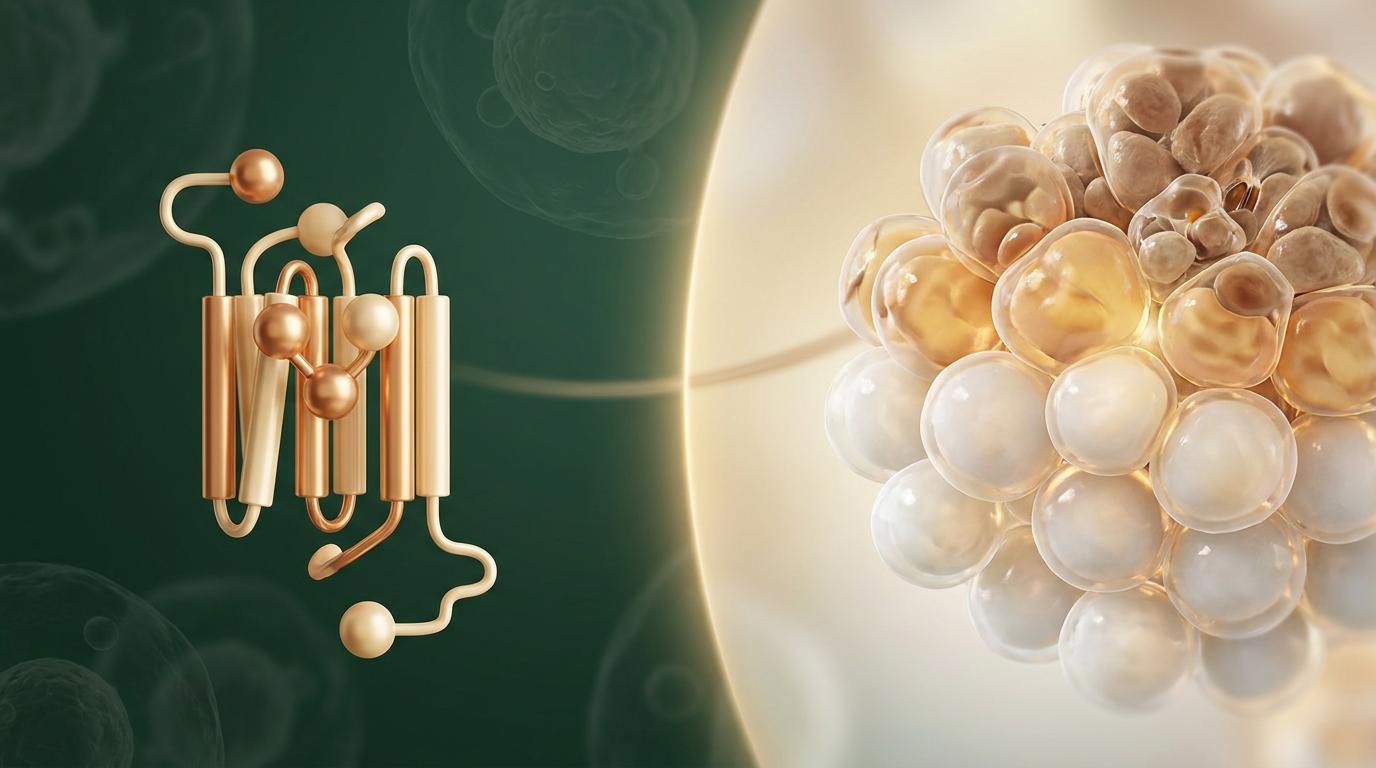
How GLP-1 Drugs Reshape Fat at the Cellular Level
To understand why fat grafts struggle in GLP-1 patients, you need to understand what these drugs do to adipose tissue. The mechanism goes far beyond simple appetite suppression.
GLP-1 receptor agonists trigger a process called adipocyte browning, a shift where white fat cells, the large, energy-storing kind that give faces their youthful volume, convert toward a thermogenic beige phenotype. A January 2026 study in the European Journal of Pharmacology demonstrated that tirzepatide activates the PGC-1α/UCP1 signaling axis through a cAMP-dependent pathway. In plain language, the drug turns fat cells from storage units into calorie-burning furnaces.
That is great for weight loss. It is devastating for fat graft survival.
Fat grafting depends on three things: healthy adipocytes that can survive the transfer, adipose-derived stem cells that can differentiate into new fat tissue, and rapid revascularization to supply the graft with blood. GLP-1 drugs interfere with all three.
First, enhanced lipolysis through upregulation of ATGL and HSL enzymes means fat cells are being broken down faster than they can establish themselves in their new location. Second, the suppression of white adipogenic differentiation in stem cells means fewer progenitor cells are available to generate fresh fat tissue. Third, the inflammatory and angiogenic signaling that drives new blood vessel formation during the critical revascularization window gets modulated in ways that may delay or impair graft take.
The Clinical Evidence Is Stacking Up
Three studies published in June 2026 paint a consistent picture.
The abdominoplasty study (Bruno et al., 45% complication rate in semaglutide-continued patients): Researchers at Tor Vergata University of Rome divided 80 patients into four groups based on when they stopped semaglutide before lipoabdominoplasty. The group that continued the drug until surgery experienced wound dehiscence, infection, and seroma formation at nearly five times the rate of controls. A two-week washout brought the rate down to 30 percent. Four weeks normalized it to 10 percent.
The facial filler case series (Avelar et al., 17.9% average weight loss before treatment): Published in Clinical, Cosmetic and Investigational Dermatology, this multicenter study from Latin America tracked 15 women aged 30 to 50 who had lost significant facial volume on GLP-1 drugs. Treatment with poly-L-lactic acid and hyaluronic acid fillers reduced facial laxity scores from 4.5 to 2.6 at 90 days, with 85 percent showing measurable wrinkle improvement.
The narrative review (Venza & Venza, higher wound dehiscence in semaglutide users): Published in Aesthetic Plastic Surgery, this comprehensive review confirmed that GLP-1-associated weight loss coincides with clinically relevant lean-mass reductions that influence tissue quality and contouring strategy. Semaglutide users showed 5.19 percent wound dehiscence versus 2.78 percent in matched controls.
What This Means If You Are on a GLP-1 Drug
If you are taking semaglutide, tirzepatide, or any GLP-1 receptor agonist and considering cosmetic surgery, the emerging evidence points to several practical considerations.
Timing matters enormously. Stop GLP-1 therapy at least four weeks before surgery. The Rome study showed this window effectively normalizes surgical outcomes to match drug-naïve patients. Two weeks is not enough; the 30 percent complication rate at that interval remains three times higher than controls.
Fat grafting may require special planning. The biology of GLP-1-mediated weight loss works against graft survival. Surgeons may need to over-correct, use alternative volumization strategies, or consider waiting until the patient has been off GLP-1 therapy for several months before attempting fat transfer.
The Ozempic face problem is real but solvable. Facial volume loss from GLP-1 drugs responds well to dermal fillers. The Latin American case series showed that a combination of poly-L-lactic acid and hyaluronic acid can meaningfully restore facial contour, with 87 percent of patients reporting satisfaction at 90 days.
For patients on retatrutide, the emerging triple agonist that targets GLP-1, GIP, and glucagon receptors simultaneously, the concern may be even more pronounced. Retatrutide's glucagon receptor agonism adds an additional layer of lipolytic stimulation, and its growing off-label use in bodybuilding communities raises the stakes for individuals pursuing both leanness and cosmetic enhancement.
The Bigger Picture
This body of research signals something important about how the medical system needs to adapt to the GLP-1 era. These drugs are not just changing how people eat. They are changing the fundamental biology of adipose tissue in ways that ripple across specialties from cardiology to plastic surgery to dermatology.
The Lancet Diabetes and Endocrinology review published in May 2026 made the case explicitly: obesity medications deliver multisystem benefits that extend far beyond weight loss, affecting cardiovascular, reproductive, neuropsychiatric, and metabolic pathways. But those same multisystem effects create multisystem complications when patients move between specialties.
Plastic surgeons are now developing standardized perioperative protocols specifically for GLP-1 patients. The consensus is forming around a four-week minimum washout before any body contouring procedure, individualized risk assessment for patients on higher-dose or multi-agonist formulations, and multidisciplinary coordination between endocrinologists, anesthesiologists, and surgeons.
The science is moving fast. What was a theoretical concern in 2024 has become an evidence-based clinical challenge in 2026. For the millions of patients navigating both weight management and aesthetic goals, understanding this intersection is not optional. It is essential.
Evidence Grade
Evidence Grade: B+ (Strong Emerging Evidence). Multiple peer-reviewed studies from 2026, including a retrospective cohort study (n=80), a multicenter case series (n=15), and a PRISMA-compliant scoping review, converge on consistent findings. The mechanistic evidence from preclinical studies on adipocyte browning strengthens the clinical observations. Limited by the absence of prospective randomized trials specifically designed for this question.
Sources
1. Bruno A, Calicchia A, Schirosi M. Impact of Preoperative Semaglutide Discontinuation Timing on Postoperative Outcomes in Aesthetic Abdominoplasty. Aesthetic Plast Surg. 2026 Jun 12. PMID: 42286330.
2. Chalhoub X, Yang Ng Z. Do GLP-1 Receptor Agonists Sabotage Fat Grafts? A Scoping Review. Aesthet Surg J. 2026 Jun 1. PMID: 42219269.
3. Avelar LET et al. Aesthetic Use of PLLA and HA Fillers in GLP-1-Driven Weight Loss: Case Series from Latin America. Clin Cosmet Investig Dermatol. 2026 Jun 17. PMID: 42328491.
4. Venza M, Venza I. GLP-1 Receptor Agonists in Aesthetic Surgery: Perioperative Safety and Body Contouring Strategies. Aesthetic Plast Surg. 2026 Jun 15. PMID: 42298156.
5. Sun Y et al. Tirzepatide Reduces Intracellular Lipid Content by Promoting Browning of White Fat via cAMP Signaling. Eur J Pharmacol. 2026 Feb 10. PMID: 41506434.
6. Savas M et al. Beyond Weight Loss: Multisystem Benefits of Obesity Medications. Lancet Diabetes Endocrinol. 2026 May 28. PMID: 42208956.
Medical Disclaimer: This article is for educational purposes only and does not constitute medical advice. Peptide therapies and GLP-1 receptor agonists should only be used under the supervision of a qualified healthcare provider. Oria BioStack provides science-based educational content to help readers have informed conversations with their physicians. Always consult your healthcare provider before starting, stopping, or modifying any medication or treatment protocol.
Related Compounds
Build Your Personalised Protocol
Turn your research into a personalised supplementation protocol with the BioStack Generator.