
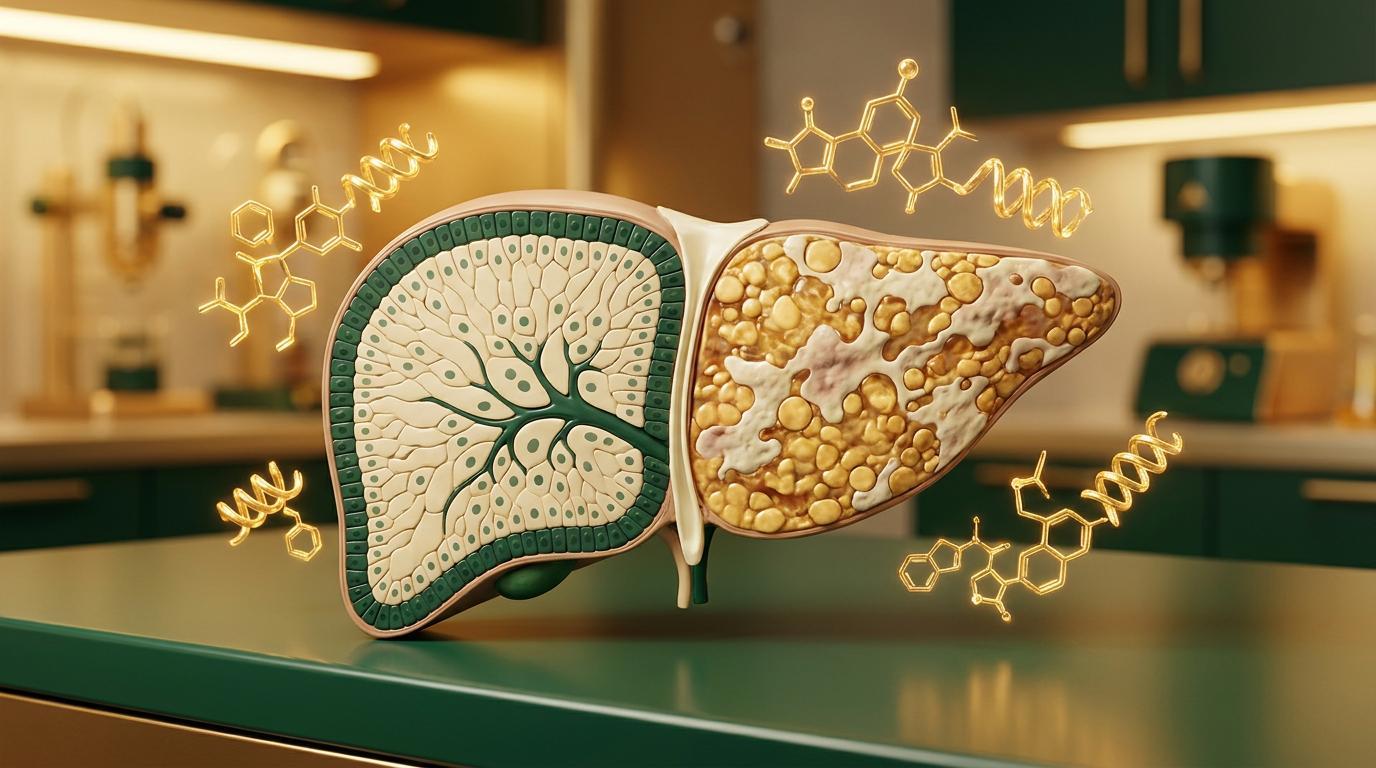
Survodutide Shrinks Liver Fat by 84% in Phase 3 Trial — A New Era for Fatty Liver Disease
A landmark Nature Medicine trial shows survodutide dramatically reduces liver fat and body weight in patients with fatty liver disease. Here's what the data actually says.
Here's a number that should stop you mid-scroll: 84.2% of patients on survodutide achieved at least a 30% reduction in liver fat within 48 weeks. That's not a typo. In a rigorous Phase 3 trial published this month in Nature Medicine, the dual glucagon/GLP-1 receptor agonist survodutide didn't just nudge the needle on fatty liver disease — it obliterated it for the vast majority of participants.
If you've been following the peptide and GLP-1 space, you know survodutide as the "next-gen" weight loss drug from Boehringer Ingelheim and Zealand Pharma. But this trial — called SYNCHRONIZE-MASLD — signals something bigger than weight loss. It positions survodutide as a potential first-line treatment for a liver disease that affects roughly one in four adults globally, and for which treatment options have been almost nonexistent until now.
The SYNCHRONIZE-MASLD Trial: What They Tested
SYNCHRONIZE-MASLD was a randomized, double-blind, placebo-controlled Phase 3 trial — the gold standard for clinical evidence. Led by Lee M. Kaplan of the Obesity and Metabolism Institute in Boston and Arun J. Sanyal of Virginia Commonwealth University's Stravitz Sanyal Institute for Liver Disease, the study enrolled 216 adults with obesity (BMI ≥30 kg/m², or ≥27 kg/m² with at least one obesity complication) and at-risk metabolic dysfunction-associated steatotic liver disease — the clinical term for fatty liver with evidence of inflammation or fibrosis.
Participants were randomized 2:1 to receive either once-weekly subcutaneous survodutide at 6.0 mg (146 patients) or placebo (70 patients) for 48 weeks. The co-primary endpoints were the proportion of patients achieving a ≥30% reduction in liver fat as measured by MRI-proton density fat fraction (MRI-PDFF), and percentage change in body weight from baseline.
The Results: Striking on Both Fronts
The numbers are hard to overstate. Using the efficacy estimand (which measures the drug's effect in patients who actually took it as directed):
Liver fat reduction: 84.2% of survodutide patients achieved ≥30% liver fat reduction versus 24.3% on placebo (P < 0.0001). Even under the more conservative treatment regimen estimand — which includes all randomized patients regardless of adherence — the gap remained dramatic: 68.5% versus 28.6%.
Body weight loss: Patients on survodutide lost an average of 12.2% of body weight compared to just 1.0% on placebo (efficacy estimand, P < 0.0001). Under the treatment regimen estimand: -8.7% versus -1.4%.
Both co-primary endpoints were met with high statistical significance. The liver fat numbers are particularly remarkable because the threshold for clinical significance in MASH trials is typically much lower — even a 30% relative reduction in liver fat is considered meaningful. Survodutide delivered that to nearly five out of six patients.
Why Dual Agonism Changes the Equation
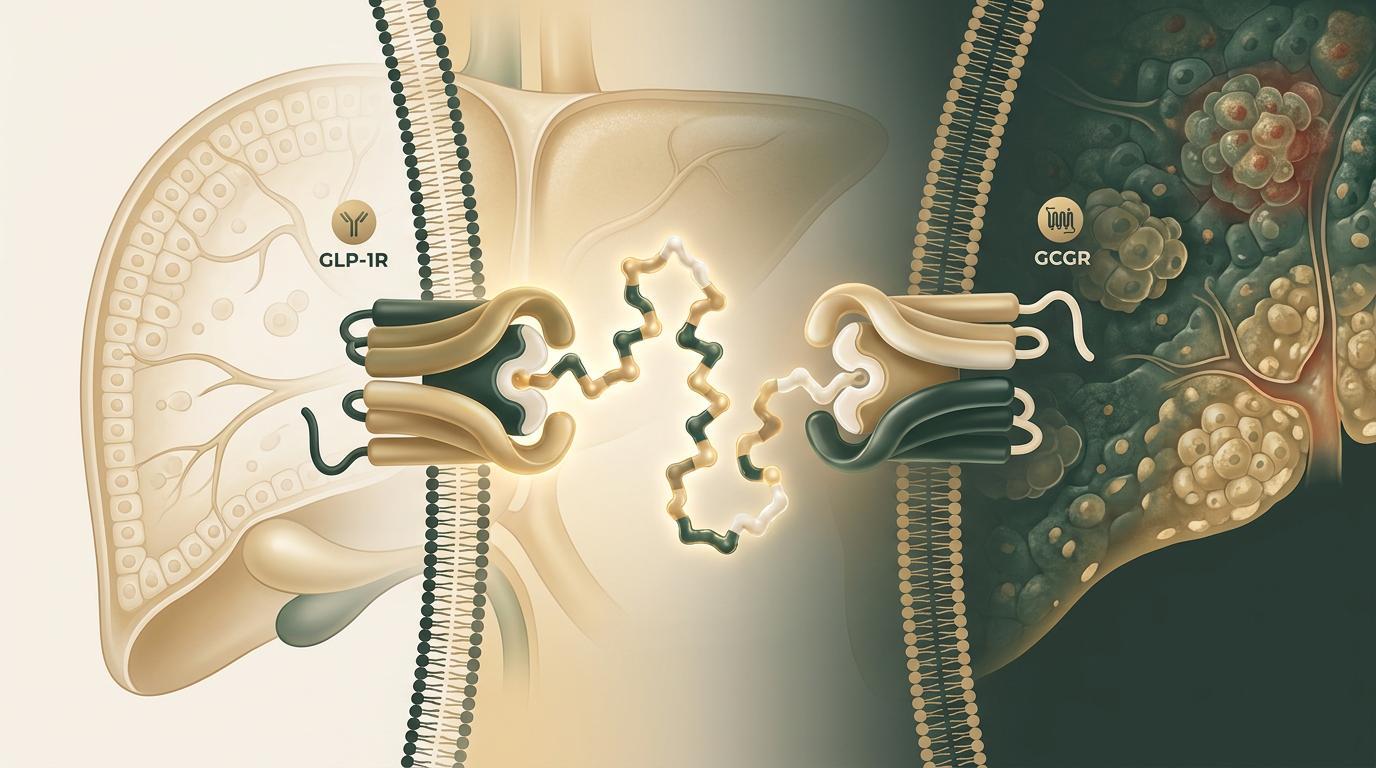
Survodutide isn't a standard GLP-1 receptor agonist like semaglutide or tirzepatide. It's a dual agonist that activates both the glucagon receptor (GCGR) and the GLP-1 receptor. This dual mechanism is what makes it particularly interesting for liver disease.
GLP-1 receptor agonism drives appetite suppression, improved insulin sensitivity, and weight loss — effects shared by drugs like Ozempic and Mounjaro. But glucagon receptor activation adds a second dimension: it promotes fat oxidation in the liver, increases energy expenditure, and directly targets hepatic fat metabolism. For a disease literally defined by excess fat accumulation in the liver, that second mechanism could be the difference between managing symptoms and actually resolving the underlying pathology.
A plain language review published alongside the trial in Therapeutic Advances in Gastroenterology (by researchers from UT Southwestern, University of Ulster, and the Obesity Action Coalition) explains the dual mechanism in accessible terms: survodutide helps the body both reduce fat storage in the liver and burn existing liver fat more efficiently, while simultaneously reducing the overall caloric load through appetite suppression.
The MASH Crisis: Why This Matters Now
Metabolic dysfunction-associated steatohepatitis (MASH) — formerly known as NASH — is the advanced, inflammatory form of fatty liver disease. It's the fastest-growing reason for liver transplantation in the United States and is projected to become the leading indication for liver transplants within the next decade. An estimated 6-8% of the global adult population has MASH, and most don't know it until the disease has progressed to fibrosis or cirrhosis.
Until recently, there was exactly one FDA-approved medication for MASH: resmetirom (Rezdiffra), approved in March 2024. That approval was itself a watershed moment after decades of failed drug candidates. But resmetirom works through thyroid hormone receptor agonism — a completely different mechanism — and its approval was conditional, based on liver fat reduction rather than hard clinical outcomes like progression to cirrhosis.
Survodutide's SYNCHRONIZE-MASLD data opens the door to a second mechanism-based approach, this time from the incretin space that has already transformed obesity and diabetes treatment. If the liver fat reductions seen at 48 weeks translate to actual histological improvement of MASH — which remains to be confirmed in longer trials — survodutide could become a first-in-class dual agonist for liver disease.
Safety Profile: What to Watch
The most frequently reported adverse events with survodutide were gastrointestinal — nausea, vomiting, diarrhea — which are consistent with the GLP-1 agonist class. These events were most common during the dose escalation phase and were generally mild to moderate in severity. This is the same pattern seen with semaglutide and tirzepatide: the body adjusts, and GI symptoms typically diminish after the first few weeks.
The trial was 48 weeks — long enough to demonstrate efficacy but not long enough to assess the durability of liver fat reduction or the drug's effect on hard endpoints like fibrosis progression, liver-related mortality, or need for transplantation. Those questions will require longer follow-up studies, which are presumably underway.
What This Means for the Peptide and Weight Loss Space
The SYNCHRONIZE-MASLD results have implications beyond liver disease. They validate the dual glucagon/GLP-1 agonist mechanism as clinically superior to single-target approaches for metabolic disease. This is the same rationale behind triple agonists like retatrutide (GLP-1/GIP/glucagon), which has shown even more dramatic weight loss in its own trials.
For the peptide therapy community, survodutide represents a new category: peptides that target the liver directly, not just appetite or blood sugar. If you're currently using BPC-157 for gut health or TB-500 for tissue repair, the idea that a synthetic peptide can reverse liver fat accumulation by 84% in under a year is a significant expansion of what peptide therapeutics can do.
The commercial timeline is worth watching. Boehringer Ingelheim holds the global development and commercialization rights (licensed from Zealand Pharma). Based on typical Phase 3-to-approval timelines, survodutide could file for FDA approval for MASH within 12-18 months, potentially joining or following its obesity indication.
The Oria Take
We've covered survodutide before as a weight loss compound, and the SYNCHRONIZE-MASLD data doesn't change our general guidance: survodutide is not yet approved, and the gray market versions circulating in peptide communities are unregulated and potentially dangerous. But the Nature Medicine data is hard to ignore.
An 84% liver fat reduction rate in a Phase 3 trial is the kind of number that reshapes treatment guidelines. If survodutide earns FDA approval for MASH, it could become the standard of care for a disease that currently has almost no pharmacological options. For anyone with metabolic syndrome, insulin resistance, or a family history of liver disease, this is a compound worth watching closely.
We'll update our survodutide guide as more data emerges — particularly histological endpoints from longer trials and any FDA filing announcements.
Evidence Grade: A — Phase 3, randomized, double-blind, placebo-controlled trial published in Nature Medicine with statistically significant results on both co-primary endpoints. Limitations: 48-week duration, US/Spain-only enrollment, and liver fat reduction rather than histological endpoints.
This article is for informational purposes only and does not constitute medical advice. Survodutide is an investigational drug not yet approved by the FDA. Always consult a qualified healthcare provider before starting any peptide or pharmaceutical regimen. Oria BioStack provides educational content about peptide science — we do not sell or distribute peptides.
Related Compounds
Explore Reconstitution Math & Research Reports
Use our interactive U-100 Reconstitution Calculator or browse evidence-graded literature summaries.