

Thymosin Alpha-1 in Cancer Immunotherapy: New Mechanism Restores Immunity After Chemo
Three 2026 studies reveal how thymosin alpha-1 restores antitumor immunity after chemotherapy, reverses T-cell exhaustion, and synergizes with checkpoint inhibitors.
The Discovery Hiding in Plain Sight
For decades, thymosin alpha-1 has been known primarily as an immune-boosting peptide — a thymic hormone that helps train the immune system. Hospitals in Europe and Asia have used it for years as an adjunct therapy for hepatitis B and as a general immune modulator. But three new peer-reviewed studies published in 2026 are pushing Tα1 into a much more exciting territory: cancer immunotherapy.
And the mechanism they uncovered is genuinely surprising.
A New Mechanism: How Tα1 Restores Immunity After Chemo
The headline study, published in Cancer Research (June 2026) by a team at Southeast University in Nanjing, China, identified something no one had seen before: chemotherapy depletes circulating thymosin alpha-1 levels in cancer patients and tumor-bearing mice.
Why does that matter? Because when Tα1 drops, the immune system loses a critical tool for recognizing and attacking cancer cells that survive treatment.
Here's the mechanism in plain language:
Step 1: Chemotherapy kills cancer cells, but those dying cells release tiny packages called apoptotic bodies. Normally, these bodies are poorly immunogenic — they don't trigger a strong immune response.
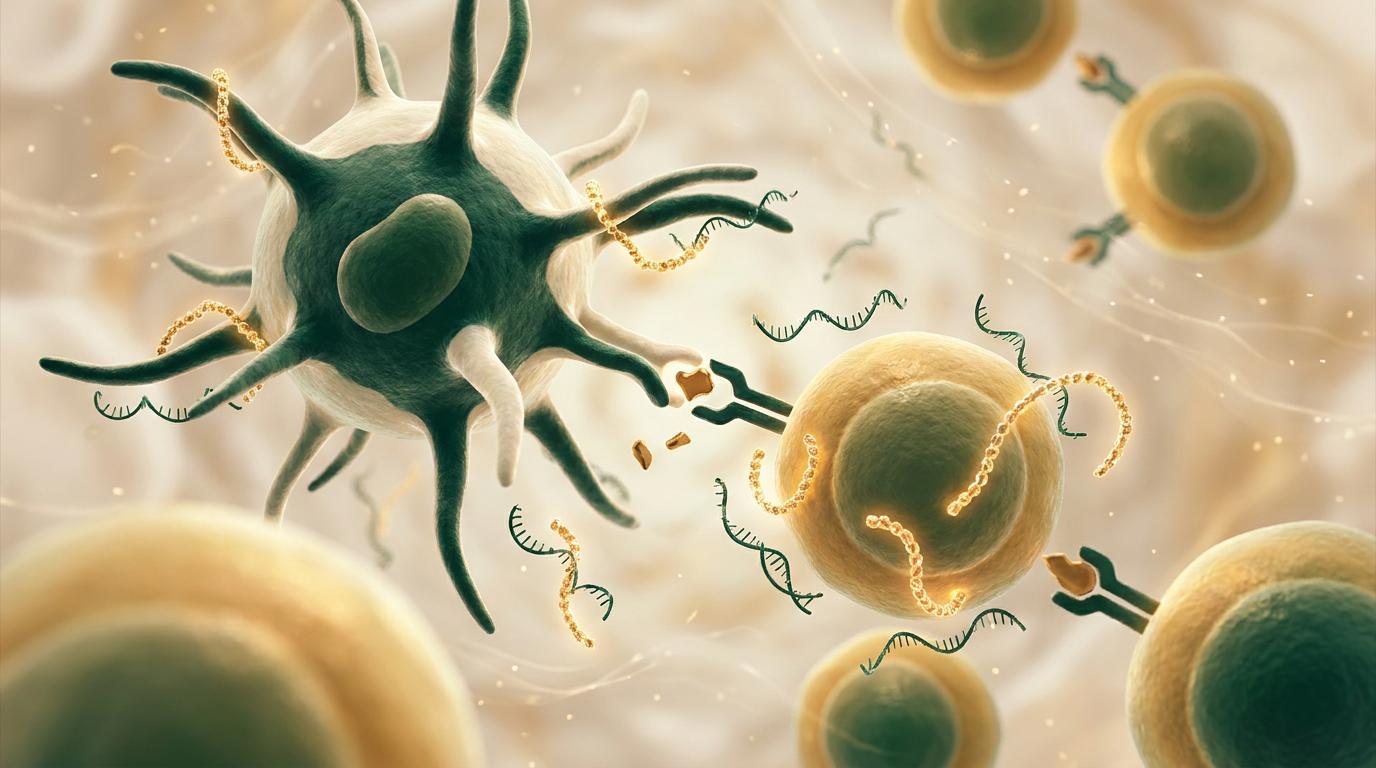
Step 2: Tα1 binds to these apoptotic bodies and interacts with microRNAs inside them, specifically a molecule called miR146a-5p.
Step 3: After the apoptotic bodies are swallowed by dendritic cells (the immune system's scouts), Tα1 protects miR146a-5p from being destroyed by enzymes in the lysosome.
Step 4: The protected miR146a-5p activates Toll-like receptor 7 (TLR7) on dendritic cells, which triggers their maturation and migration to lymph nodes.
Step 5: Those activated dendritic cells then present tumor antigens to CD8+ T cells, effectively teaching the immune system to recognize and attack the remaining cancer cells.
The researchers showed that supplementing Tα1 after chemotherapy produced strong synergy — tumors shrank significantly more than with chemo alone, but only in mice with high miR146a-5p expression and functional TLR7 signaling. This isn't just correlation; it's a clearly mapped molecular pathway.
Reversing T-Cell Exhaustion: The CD8+ Angle
A complementary study from Amity University in India (Asian Pacific Journal of Cancer Prevention, June 2026) tackled a different but related problem: T-cell exhaustion.
When the immune system fights cancer for a long time, CD8+ T cells — the killer cells that directly destroy tumors — become exhausted. They express exhaustion markers like PD-1, TIM-3, and LAG-3, and they stop producing the cytokines (IL-2, IFN-γ, TNF-α) needed to kill cancer cells.
The Indian team tested Tα1 on human CD8+ T cells in the lab under four conditions: untreated, stimulated with CD3/CD28 antibodies, treated with Tα1 alone, and the combination of all three.
The results were striking:
Combined treatment significantly boosted the proliferation index compared to any single treatment
Activation markers (CD69, CD25, HLA-DR) surged on the T-cell surface
Cytokine production (IL-2, IFN-γ, TNF-α) increased substantially
Exhaustion markers (PD-1, TIM-3, LAG-3) were reduced in T cells that had been driven to exhaustion
In other words, Tα1 didn't just activate fresh T cells — it partially reversed the exhaustion state of already-tired T cells. That's a big deal for cancer patients whose immune systems have been fighting the disease for months or years.
The Review: Tα1 + Checkpoint Inhibitors
A comprehensive review published in Frontiers in Immunology (May 2026) from Huazhong University of Science and Technology pulled all the evidence together. The authors examined preclinical and clinical studies combining Tα1 with immune checkpoint inhibitors (ICIs) like pembrolizumab and nivolumab.
Their conclusion: Tα1 addresses several of the key limitations that prevent checkpoint inhibitors from working in more patients.
Checkpoint inhibitors work by releasing the brakes on the immune system — they block PD-1 or CTLA-4 signals that tumors exploit to hide from T cells. But they only work well in about 20-40% of patients, depending on cancer type. The rest have tumors that create immunosuppressive microenvironments that ICIs alone can't overcome.
Tα1 appears to help by:
• Enhancing immune competence in immunosuppressed patients
• Regulating excessive immune activation (reducing immune-related adverse events from ICIs)
• Exerting direct antitumor effects independent of the checkpoint pathway
The review noted that preliminary clinical data shows manageable safety profiles for the combination, though large-scale randomized trials are still needed.
What This Means for Cancer Patients
These three papers collectively paint a picture of Tα1 as a multi-pronged ally in cancer treatment:
During chemotherapy: Tα1 levels drop, but supplementing them can restore the immune system's ability to recognize and attack residual cancer cells through the miR146a-5p/TLR7 pathway.
During immunotherapy: Tα1 can enhance the effectiveness of checkpoint inhibitors while potentially reducing their side effects.
For exhausted patients: Tα1 can partially reverse T-cell exhaustion, giving the immune system a second wind.
None of this means Tα1 is a cancer treatment on its own. But as a combination therapy — paired with chemo, checkpoint inhibitors, or both — the evidence is building rapidly.
The Oria Take
Thymosin alpha-1 has been quietly used as an immune modulator for decades, primarily in Asia and Europe. These new studies are the first to map its precise molecular mechanism in cancer immunity, and the results are compelling enough to expect more clinical trials in the near future.
For the peptide-curious, this is worth watching. Tα1 is already available through compounding pharmacies and research suppliers, and its safety profile is well-established. The cancer immunotherapy angle adds a new dimension to what was already considered a versatile immune peptide.
If you're currently undergoing cancer treatment, these studies are not a reason to self-prescribe Tα1. They are reason to have a conversation with your oncologist about whether Tα1 might be appropriate as part of your treatment protocol — especially if checkpoint inhibitors are being considered.
Evidence Grade
Evidence Grade: B+ (Strong Preclinical + Early Clinical) — Three independent peer-reviewed studies in high-impact journals (Cancer Research, Frontiers in Immunology, APJCP) with clearly mapped mechanisms and reproducible in vitro and in vivo data. Limited by the absence of large-scale randomized controlled trials in humans. The mechanism is well-characterized, but clinical translation is still early.
Sources
1. Wei Y et al. "Thymosin Alpha-1 Restores Chemotherapy-Induced Antitumor Immunity by Chaperoning a MicroRNA Ligand of TLR7 in Dendritic Cells." Cancer Research, June 15, 2026. doi: 10.1158/0008-5472.CAN-25-5547
2. Mishra S et al. "Thymosin α1 Augments CD8+ T-Cell Activation and Reverses Exhaustion In Vitro." Asian Pacific Journal of Cancer Prevention, June 1, 2026. doi: 10.31557/APJCP.2026.27.6.2089
3. Guo H, Li R. "Thymosin α1 combined with immune checkpoint inhibitors: synergistic remodeling of the tumor immune microenvironment." Frontiers in Immunology, May 29, 2026. doi: 10.3389/fimmu.2026.1762151
Medical Disclaimer
This article is for informational purposes only and does not constitute medical advice. Thymosin alpha-1 is not FDA-approved for cancer treatment. Always consult with a qualified healthcare provider before starting any peptide therapy, especially if you are undergoing cancer treatment. The studies discussed are early-stage and require larger clinical trials to confirm efficacy and safety in humans.
Related Compounds
Explore Reconstitution Math & Research Reports
Use our interactive U-100 Reconstitution Calculator or browse evidence-graded literature summaries.