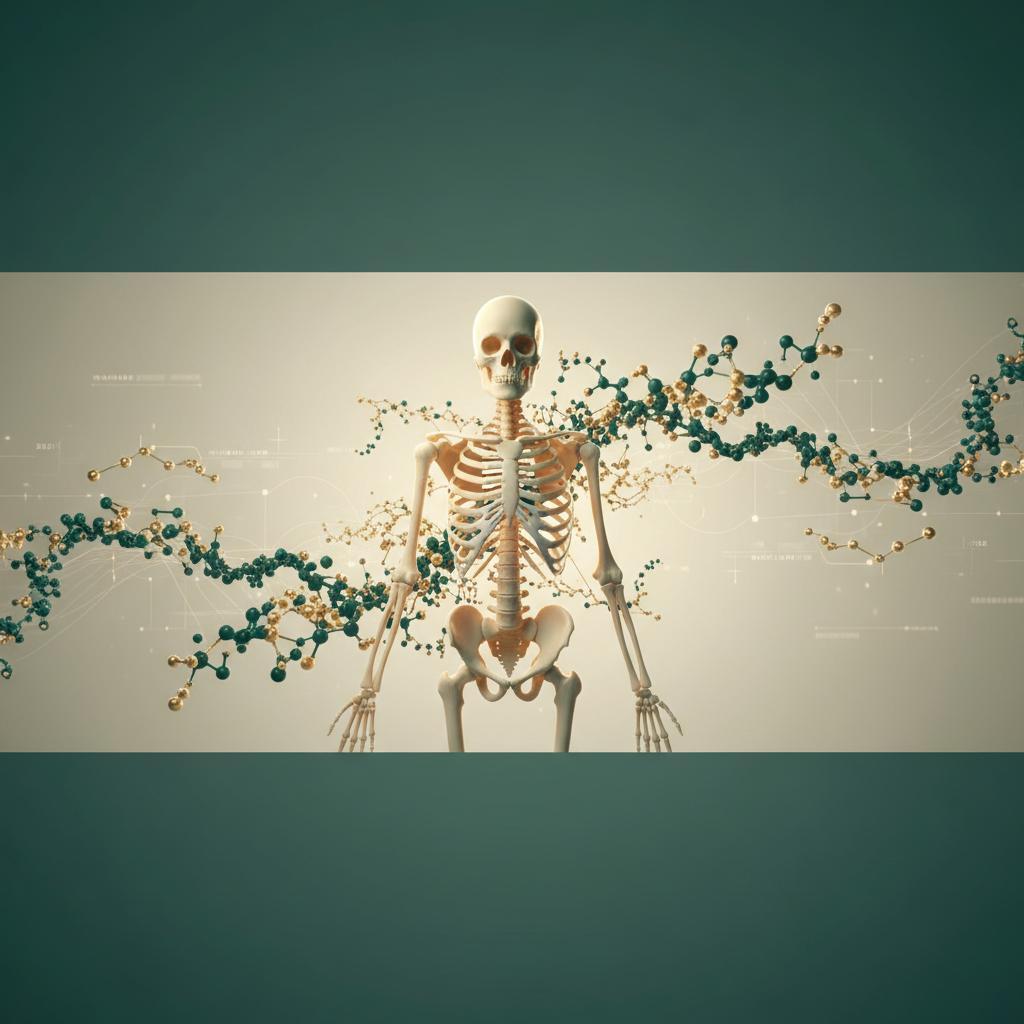
GLP-1 receptor agonists have transformed obesity and diabetes treatment — but a paradox emerges when it comes to bone. Large observational studies suggest fewer fractures, while randomized trials with major weight loss show lower bone density. The honest interpretation is nuanced.
60-Second Clinical Brief
Research · November 18, 2026GLP-1 receptor agonists have transformed obesity and diabetes treatment — but a paradox emerges when it comes to bone. Large observational studies suggest fewer fractures, while randomized trials with major weight loss show lower bone density. The honest interpretation is nuanced.
For the 50+ million people worldwide now taking a GLP-1 receptor agonist (semaglutide, tirzepatide, or one of the other agents), bone health has become an unexpected concern.
Act 1: The protective signal. A 2026 JAMA Network Open trial using TriNetX data — 133,606 adults with type 2 diabetes, followed for up to 3 years — found that initiating a GLP-1 RA versus a DPP-4 inhibitor was linked to 39% lower 3-year fragility fracture risk (HR 0.79, 95% CI 0.76–0.83).
The adjusted hazard ratio remained 0.81 even after mediating for BMI and HbA1c changes. Bottom line: real-world patients on GLP-1 RAs may actually suffer fewer fractures.
Act 2: The concerning signal. A 2026 systematic review of 8 RCTs (n=493) found that the two trials reporting the largest weight loss both showed reduced lumbar spine and total hip BMD.
The weight loss — BMD loss correlation was r=0.32 at the thigh and r=0.17 at the femoral neck. Bottom line: the drug-associated weight loss that drives metabolic benefits may come at a cost to bone.
Act 3: The diabetes-status split. Perhaps the most important nuance: the fracture benefit appears confined to patients with type 2 diabetes.
In patients without diabetes (using GLP-1 RAs for weight loss alone), the JAMA trial showed a possible harm signal (HR 1.13, 95% CI 1.04–1.23 for fractures), and the BMD data consistently shows reductions — especially in non-diabetic users.
Bottom line: the bone story is not uniform; it differs fundamentally by diabetes status.
1. Fractures — the protective signal (observational): Hamad CD et al., JAMA Netw Open 2026;9(7):e2625141. PMID 42496972 — 133,606 adults with T2D, new GLP-1 RA vs DPP-4i, up to 3y follow-up. GLP-1 RA linked to LOWER 3-year fragility fracture risk vs DPP-4i: HR 0.79 (95% CI 0.76–0.83); ARR 0.79% (0.60–0.99%); NNT 126 (101–168). Largest reductions: vertebral HR 0.68 (0.63–0.73); hip/femur HR 0.70 (0.63–0.79). Stratified: benefit in T2D (HR 0.91, 0.88–0.95); NOT in non-T2D (HR 1.13, 1.04–1.23); interaction P<.001.
2. Vertebral fractures in osteoporosis (observational): Stump K et al., Clin Spine Surg, Sep 2026 (online). PMID 42683541 — TriNetX propensity-matched, female >50 with osteoporosis.
3. Bone density — the concerning signal (randomized + matched DXA): Lai CH et al., Arch Osteoporos 2026;21(1):148. PMID 42920024 (systematic review, 8 RCTs, n=493) — semaglutide trial: ETD -0.018 g/cm² lower lumbar spine BMD (p=0.007), increased CTX (bone resorption marker). Liraglutide 3.0mg: similar BMD reductions. Liu Y et al., J Clin Endocrinol Metab 2026: weight loss correlates with bone loss (r=0.32 TH, r=0.17 FN). Without DM: greater TH loss on GLP-1 RA vs controls.
Beaudart C et al., Drugs 2026;86(10):1661-1691. PMID 42730869 — 1,250,717 individuals: no significant bone/joint effect; lean mass loss largely related to weight loss.
These are measuring different things. The JAMA study counts real fractures (hard outcome), the DXA studies measure bone density (surrogate). They can both be true. Weight loss itself reduces bone density — mechanical loading drops.
Fracture protection may come from fewer falls (better balance, less mass, improved mobility), better glycemia, and anti-inflammatory effects — not denser bone. The diabetes-status split is key: benefit in T2D, possible harm (HR 1.13) in non-T2D.
Bottom line: for a thin, older, non-diabetic person on GLP-1 for weight loss, monitor bone; the density drop is real and the fracture benefit is not established in that group.
C — Large observational data suggest fewer fractures, but the randomized DXA evidence shows reduced bone density at the doses producing the most weight loss. Mechanism unresolved, no agent-specific fracture-endpoint RCTs exist. Guidance is provisional.
Sources: 1. PMID 42496972 — JAMA Netw Open 2026 (fracture benefit, T2D) 2. PMID 42920024 — Arch Osteoporos 2026 (systematic review, BMD reduction) 3. PMID 42730869 — Drugs 2026 (meta-analysis, muscle/bone/joint) 4. PMID 41655226 — J Clin Endocrinol Metab 2026 (SEM/TIR DXA, DM-status split) 5. PMID 41989133 — J Bone Miner Res 2026 (clinical vignette, monitoring) 6. PMID 42683541 — Clin Spine Surg 2026 (vertebral fractures, osteoporosis)
- /blog/tirzepatide-vs-semaglutide-2026-real-world-data
- /blog/low-dose-tirzepatide-2-5mg-vs-5mg-study
(verify each returns 200 before linking; drop if 404)


Large real-world data say GLP-1 drugs reduce fragility fractures. The randomized bone-density trials say they pull density out of skeleton. Here is why both are true, and what it means for your bones.