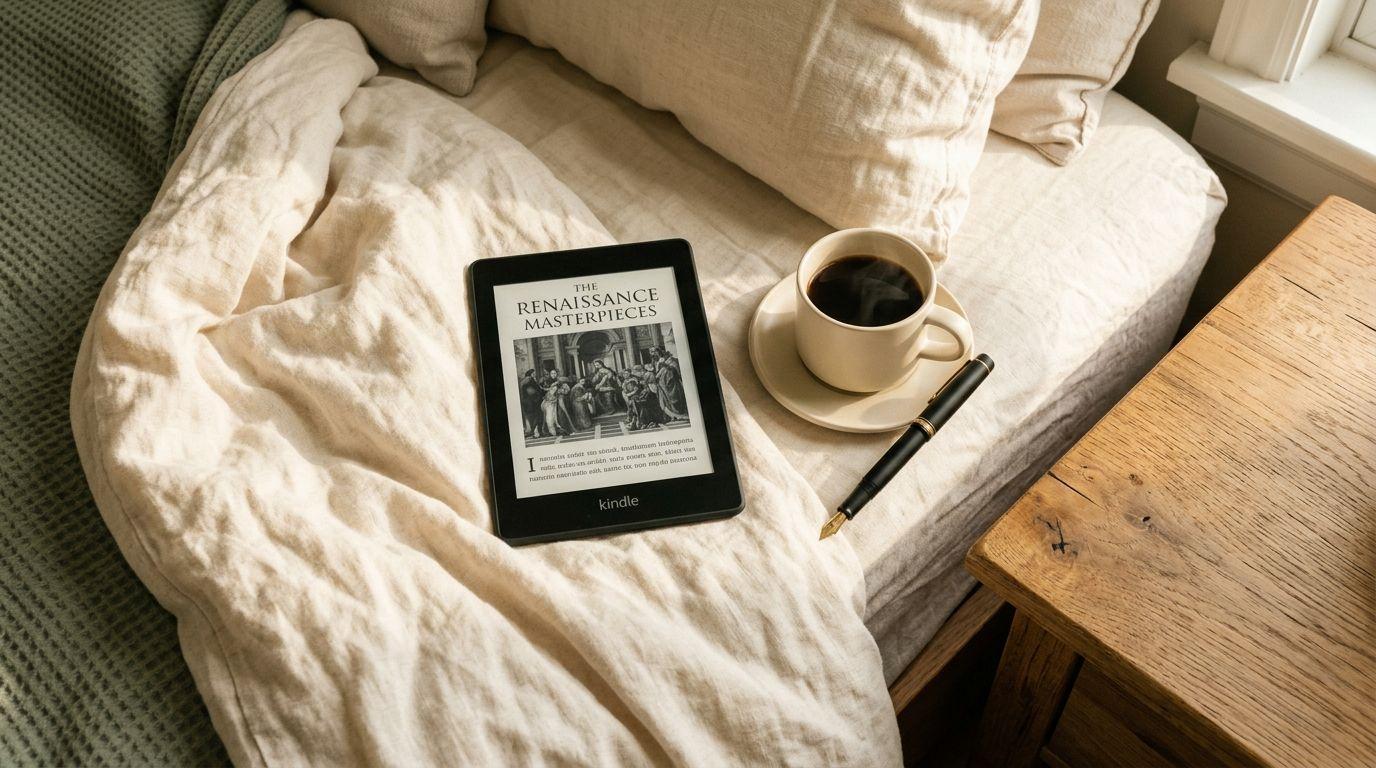
Millions of Kindle Paperwhites gather dust in drawers. Here is how to repurpose an old e-ink reader into an automated, distraction-free morning briefing—combining classical art, philosophy, and personal priorities to reclaim your first 90 minutes.
60-Second Clinical Brief
Protocol Update · November 17, 2026Millions of Kindle Paperwhites gather dust in drawers. Here is how to repurpose an old e-ink reader into an automated, distraction-free morning briefing—combining classical art, philosophy, and personal priorities to reclaim your first 90 minutes.
Open almost any nightstand drawer or bookshelf in a modern household, and you are likely to find a forgotten e-reader—an older Kindle Paperwhite (6th or 7th generation), a Kobo, or a Nook—coated in a faint layer of dust.
Bought with noble intentions, it was eventually displaced by the seductive, high-refresh-rate glow of modern smartphones and tablets.
Yet that matte, reflective, un-connected e-ink screen is one of the most powerful executive productivity tools you own.
By connecting an older e-reader to a lightweight, automated daily pipeline, you can transform a neglected piece of hardware into a dedicated, offline **Morning Daily Dossier**—a ritual that completely insulates your first 90 minutes from the toxic digital dopamine trap of smartphones.
Here is why screenless mornings transform cognitive function, and the practical blueprint for engineering your own daily e-ink briefing.
The first 60 minutes after waking represent a delicate neurochemical window.
During this transition from slow-wave sleep to wakefulness, your brain produces a surge of cortisol—known as the **Cortisol Awakening Response (CAR)**—designed to prepare your cardiovascular and metabolic systems for the day. Simultaneously, your brain waves transition from theta (creative, subconscious, plastic) to alpha (relaxed awareness) before stabilizing into beta (active, analytical focus).
When your first physical action of the day is grabbing an iPhone or Android device:
1. **Cortisol Hijack**: Urgent work Slack messages, breaking geopolitical news, and unread emails spike cortisol well beyond the physiological CAR baseline, locking your brain into emergency reactive posture.
2. **Attentional Fragmentation**: The rapid visual switching of social media and news feeds floods the nucleus accumbens with unpredictable micro-dopamine hits, degrading working memory and executive stamina for the subsequent 8 hours.
3. **Loss of Agency**: You begin the day reacting to other people's priorities, emergencies, and algorithms, forfeiting your creative autonomy before your feet touch the floor.
Electronic paper (E-Ink) differs fundamentally from LCD, OLED, and Mini-LED displays.
You do not need an expensive modern $400 color e-reader or note-taking slate. In fact, older monochrome devices—such as the Kindle Paperwhite 7th Generation (released in 2015, featuring a crisp 300 PPI Carta display)—are superior for this exact purpose:
Instead of opening a news app, your morning begins with a custom-compiled, beautifully formatted publication delivered automatically to your bedside reader.
Drawing from high-performance morning routines, an ideal Daily Dossier contains 4 to 5 curated sections:
Each day opens with a high-resolution, monochrome-optimized plate of classical Renaissance, Baroque, or Ukiyo-e artwork (e.g., Caravaggio, Dürer, Hiroshige). Absorbing a visual masterpiece in silence activates bilateral visual cortices without language processing, fostering quiet awe.
A single, deeply considered excerpt from classical Stoicism, Taoism, or existential philosophy (Marcus Aurelius, Seneca, Montaigne, Epictetus) accompanied by a brief editorial prompt to frame your perspective against daily trivialities.
One paragraph of masterwork literature or verified poetry (Rilke, Yeats, Frost, Emerson). Reading rich, complex syntax primes your language networks for clear, articulate communication.
Your top 3 needle-moving priorities for the day, followed by your core personal operating principles. Because it is printed on an un-editable page, it functions as an unyielding contract with yourself.
Creating your automated dossier requires only a few lightweight components:
1. **Content Aggregator (Local Python Script or AI Agent)**:
A lightweight Python script runs each evening at 10:00 PM on a home server, Raspberry Pi, or local computer. Using an LLM API or local script, it curates the day's artwork, pulls a philosophical passage, formats the text in clean Markdown, and attaches your active quarterly goals.
2. **EPUB / MOBI Builder**:
Using libraries like `ebooklib` or CLI tools like Calibre (`ebook-convert`), the script compiles the Markdown and images into a clean, typographically elegant `.epub` file styled with serif typography (such as Bookerly or Baskerville).
3. **Automated Dispatch**:
The script sends the EPUB as an email attachment to your personal `your_name@kindle.com` address via SMTP (or a free Resend / Mailgun tier). Amazon's Whispersync automatically downloads the document to your device while you sleep.
4. **Offline Morning Execution**:
When your alarm sounds, your phone remains completely off or docked in another room. You pick up your Kindle, open the fresh Daily Dossier, and spend 20 uninterrupted minutes with your coffee, your thoughts, and an analog notebook.
By replacing the morning smartphone barrage with a reflective, offline e-ink dossier:
Dust off that old e-reader in your drawer. It might be the highest-return biohack you implement this year.

Stopping Ozempic or Mounjaro without a structured off-ramp leads to rapid weight regain and fat overshoot. Here is the exact 8-week reverse-titration protocol, leptin defense strategy, and lean-mass preservation math.