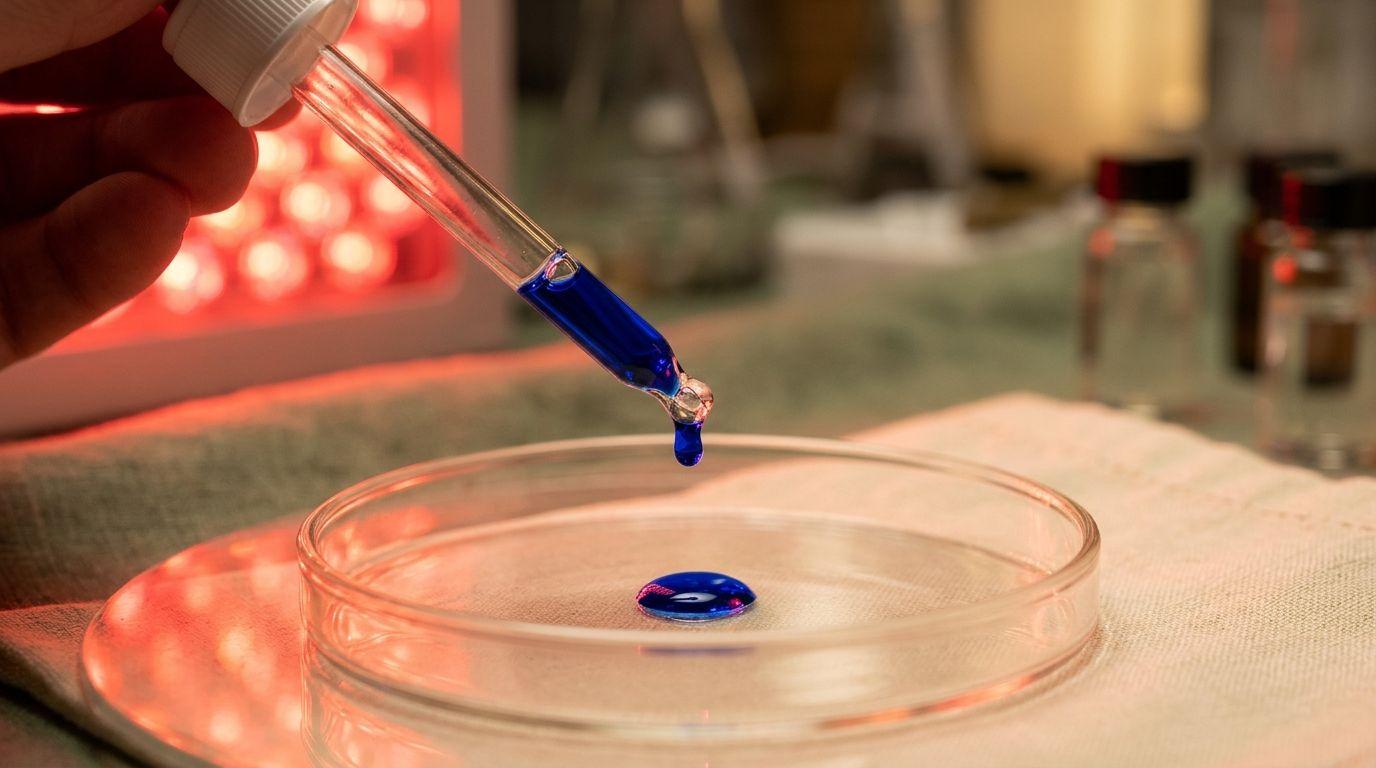
Methylene blue and 660nm red light form the ultimate mitochondrial bioenergetic duo. Discover the biophysics of cytochrome c oxidase electron donation, the hormetic dosing curve, and the critical difference between USP and industrial grade.
60-Second Clinical Brief
Research · November 17, 2026Methylene blue and 660nm red light form the ultimate mitochondrial bioenergetic duo. Discover the biophysics of cytochrome c oxidase electron donation, the hormetic dosing curve, and the critical difference between USP and industrial grade.
In the modern biohacking lexicon, few combinations have captured the imagination of longevity researchers like the pairing of **Methylene Blue (MB)** and **Photobiomodulation (Red Light Therapy)**.
Often termed the "mitochondrial dynamic duo," this protocol sits at the intersection of biophysics, quantum biology, and cellular respiration. Proponents claim enhanced cerebral ATP synthesis, rapid alleviation of executive brain fog, accelerated tissue repair, and neuroprotection against age-related neurodegenerative decline.
Yet beneath the viral enthusiasm lies a complex, double-edged sword: a strict biphasic hormetic curve where micro-doses optimize mitochondrial respiration while high doses act as potent oxidants, and where industrial contaminants present severe toxicological risks.
Here is the peer-reviewed biophysics behind why methylene blue and 660nm red light synergize, how Cytochrome c Oxidase is activated, and how to navigate pharmaceutical purity.
To understand methylene blue, we must look inside the inner mitochondrial membrane where the **Electron Transport Chain (ETC)** generates over 90% of human cellular energy:
1. Electrons derived from dietary carbohydrates and fats are stripped by NADH and FADH2.
2. These electrons flow through four multi-protein complexes: **Complex I (NADH dehydrogenase)**, **Complex II (succinate dehydrogenase)**, **Complex III (cytochrome bc1 complex)**, and **Complex IV (cytochrome c oxidase)**.
3. This electron flow pumps protons into the intermembrane space, creating an electrochemical gradient (proton motive force) that drives **Complex V (ATP synthase)** to forge adenosine triphosphate (ATP).
Under conditions of aging, chronic neuroinflammation, toxic insult, or metabolic dysfunction, Complex I and Complex III become sluggish. Electrons leak prematurely, reacting with molecular oxygen to generate damaging reactive oxygen species (superoxide radical O2•-), collapsing cellular energy production.
Synthesized in 1876 as a synthetic textile dye, methylene blue possesses a unique chemical structure: it is a phenothiazinium salt with an extraordinarily flexible redox potential (PMID: 28840449).
In biological tissue:
Because methylene blue is lipophilic, it crosses the blood-brain barrier with ease, concentrating specifically in high-energy neural tissue with dense mitochondrial populations.
Here is where photobiomodulation enters the equation:
Methylene blue is an intensely blue chromophore because it absorbs light in the red portion of the visible spectrum. Specifically, its optical absorption spectrum exhibits a massive peak between **630 nm and 670 nm**—with an absorption maximum at approximately **664 nm** (PMID: 32679261).
Concurrently, the primary photoacceptor molecule in human cells for red light is **Cytochrome c Oxidase (Complex IV)**:
1. When red light photons between 630 nm and 670 nm strike Complex IV, they dissociate inhibitory nitric oxide (NO) from the catalytic center.
2. This restores oxygen binding and accelerates the terminal reduction of O2 to water.
3. When low-dose methylene blue is present inside the cell, it absorbs red light photons at that exact 660nm wavelength, entering an excited triplet state that accelerates electron turnover to Cytochrome c Oxidase.
In preclinical and clinical trials of photodynamic therapy and neuro-optimization, combining light at 660 nm with low-dose methylene blue yields synergistic increases in mitochondrial oxygen consumption rate (OCR) and ATP output far exceeding either intervention alone (PMID: 35056711).
The most critical principle in methylene blue pharmacology is **hormesis**—a biphasic dose-response curve:
Anyone experimenting with this pathway must understand that micro-dosing is the only physiologically protective range.
Perhaps the greatest hazard in the consumer biohacking market is chemical contamination:
Never handle or research non-USP certified formulations without independent, verifiable third-party Certificate of Analysis (COA) testing.
For advanced longevity research, photobiomodulation and electron shufflers can be coordinated with targeted peptide therapeutics:
Discover your personalized mitochondrial longevity stack by completing the [Oria BioStack Longevity Assessment](https://app.oriabiostack.com/?goal=longevity&utm_source=journal&utm_medium=article&utm_campaign=methylene-blue-rlt).
This article is an educational review of published biophysical, optical, and mitochondrial literature. It is not medical advice, a diagnostic claim, or a recommendation to ingest industrial dyes or experimental compounds. Methylene blue has severe contraindications with serotonergic medications (SSRIs/SNRIs) and in individuals with Glucose-6-Phosphate Dehydrogenase (G6PD) deficiency. Always consult a qualified medical professional.
Millions search for mitochondrial longevity protocols but cycle them blindly. Here is the mechanistic difference between inner-membrane cardiolipin repair (SS-31) and metabolic exercise mimetics (MOTS-c), plus the Zone 2 timing window.